

How Old is Too Old for White Wines?
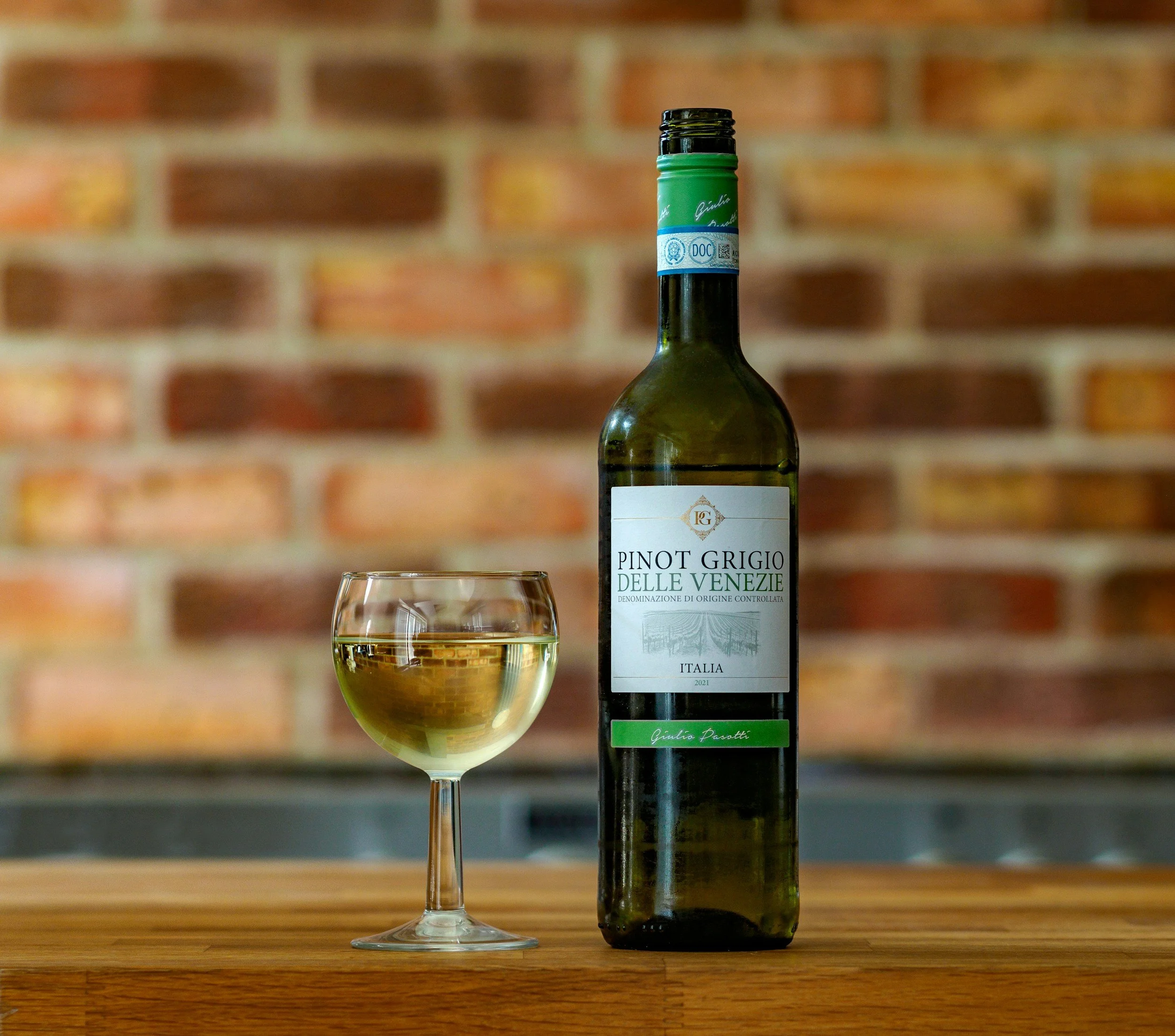
Age is just a number. Sometimes, that is. When it comes to white wines—all wines, really—there are definitely some general rules relating to how long you can expect to hold a bottle before it no longer resembles itself.
How Long Does White Wine Actually Last?
You don’t, but generally, the better the bottle, the more likely it will be nearly its best self for a few years past the vintage date on it. It’s often said that the bottle’s price is not a safe indicator of its quality but when it comes to age worthiness, price actually does figure in. Any white north of say $25 should absolutely be drinking, at worst, reasonably well for five years post vintage, and possibly longer.
Does Price or Region Matter More for Aging Wine?
The place the wine comes from is also a reliable indicator. In fact, place of origin is a much safer way to gauge a white’s lifespan than price. Certain parts of the wine world are known for producing long-lived whites. Burgundy, Alsace, the Loire Valley, Champagne (technically, the only Champagnes that are truly “white” are those labeled “Blanc de Blancs” because they are made entirely with chardonnay), the Rhône Valley and Bordeaux are probably the leading ones in France.
When Expectations Are Completely Wrong
Which brings me to the two stars of this post. I had zero expectations for both, perhaps less than zero for one of them. And yet, they both surprised me. Pleasantly. Both came from my mother-in-law’s “collection” of seemingly random and somewhat haphazardly accumulated bottles assembled over the course of decades. Some were gifts, some were intentional purchases made with the advice of retailers over the years. There is certainly nothing wrong with that buying strategy.
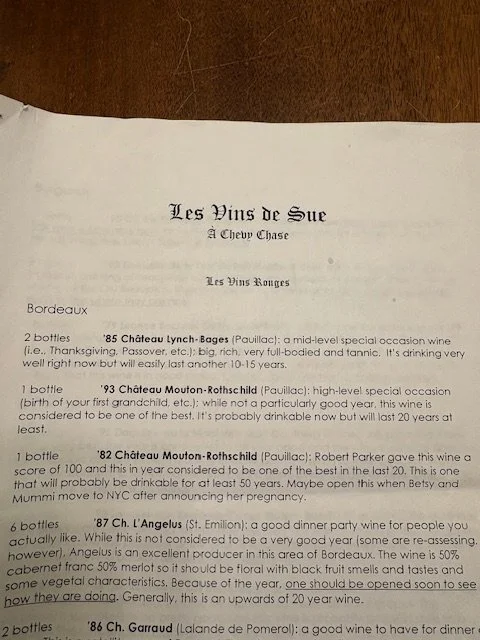
The problem is that there was never much thought given to when any of them should be consumed. About 20 years ago when she was getting ready to move I did an inventory for her. I went through each box and wrote up a quick description of the wine, where it was from, the grape/grapes and an opinion about its potential shelf life.
A 1995 Pinot Grigio That Shouldn’t Have Survived
As you can see, there were some fancy bottles. That said, there also were some less-than-fancy ones. Case in point: 1995 Tiefenbrunner Pinot Grigio. This bottle, other than its very advanced age back then—and now an additional 20 years on!—has a few things going for it.
The producer is a very well respected one. And the place the wine hails from, the Alto Adige in Northeast Italy, is perhaps Italy’s best white-wine region. Or at minimum in the conversation with Friuli and Trentino.
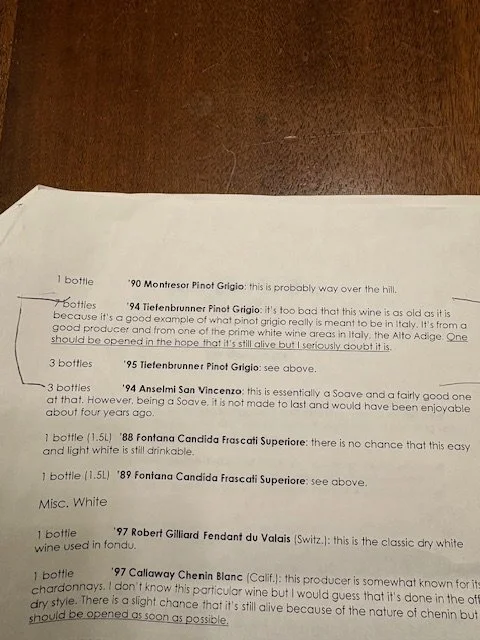
Despite these good indicators, the best I could offer was that I hoped that it was “still alive but I seriously doubt” that it would be. And that was 20 years ago when it already had about 10 years of bottle age on it.
What Happens to White Wine Over Time
I opened a bottle in January 2026 and I was shocked at what I found in my glass. The color, as you can see, was a little scary (whites do darken over time—reds lighten) but this shade of tawny was bordering on rust. It was too cold when poured so I figured the nose would be muted. It wasn’t. It was nutty and rich. It tasted of orange peel and butterscotch. It acted like an Alsace Pinot Gris (same grape, different spelling) with a bit of age. It even had that Pinot Gris-like oiliness that PG really only exhibits when it’s from Alsace.
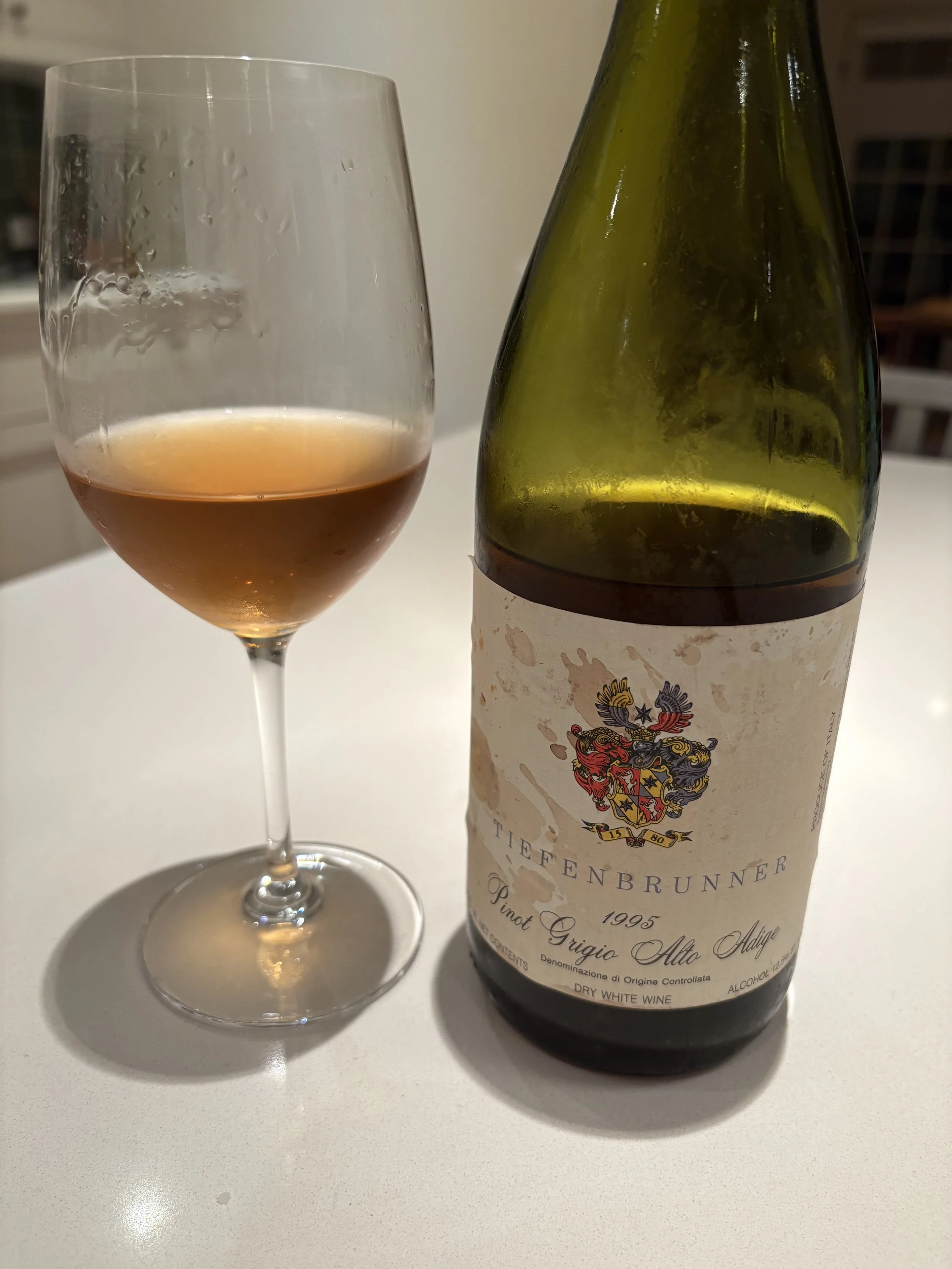
So, I guess I was wrong. But I was actually right in a way. All those years laying on its side transformed it from what it most certainly was years ago. That is, a zesty glass of citrus and minerally freshness which is PG’s calling card from the Alto Adige. I’m not sure if this was one-off luck. I’m a bit scared to open another one and tarnish this lovely, if unexpected, memory. When I do, I’ll post something about it.
The Chardonnay Test: Age vs Expectation
I actually had decently high—if a little guarded—hopes for the second bottle (opened about the same time as the PG). Being from 1987, it was certainly in the white-wine-age danger zone, but its provenance, Napa Valley, was a good one and the producer was known for making very nice Chardonnays.

The word “Reserve” on the label gave me a little pause. Back in the day, putting that on a label usually indicated a higher price than a winery’s non-Reserve bottle, so that was good, assuming there is any validity to my theory that the more the bottle sets you back in the wallet, the more likely it will outlive the typical “best by” time limitations.
But, at the same time, reserve wines also used to usually mean more oak treatment, which, in theory, justified the steeper price tag. The 1980s were the beginning of the overt—some say, over the top—oaking of Chardonnay, particularly in California, and if history has proven anything, it’s that heavily oaked Chardonnays did not end up aging gently. The reserve thing isn’t really a thing any longer and hasn’t been in years.
Anyway, on to the wine itself. The color was even bronzer than the PG, which makes sense given that it’s eight years older. But how bronze is too bronze? In this case, it wasn’t too! It was shockingly lively, with tons of nutty, apricot marmalade aromas and flavors. It really acted like a Burgundy with lots of bottle age. The funny thing is that if it actually was a Burgundy, and not a William Hill Chard, I’m not sure that I would have expected even this profile to remain after so many years. While White Burgundies do age gracefully, expecting a lovely drink after nearly 40 years in the bottle is not realistic.
So, I guess I was both wrong and right again. Sort of. Honestly, this little experiment hasn’t changed my thinking about how whites age and when they should be consumed, but it did reinforce my belief that wine and winemaking are as much about art as science. More likely, I just got really, really lucky!